Red beech

Family: Napjes carrier family

Fagus sylvatica Atropunicea

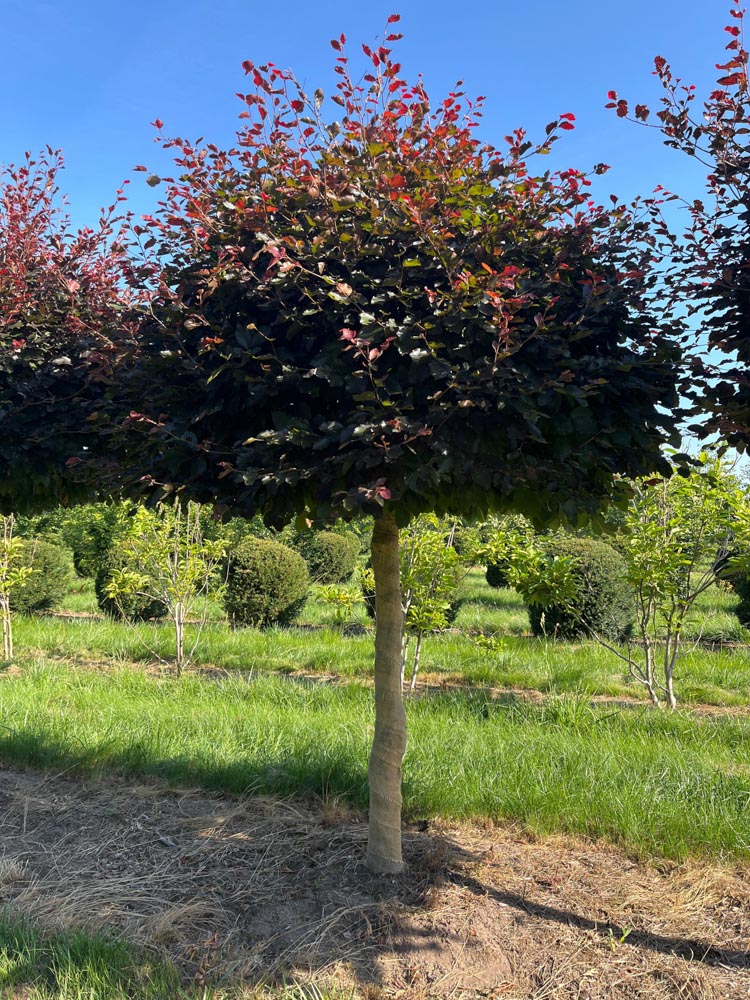
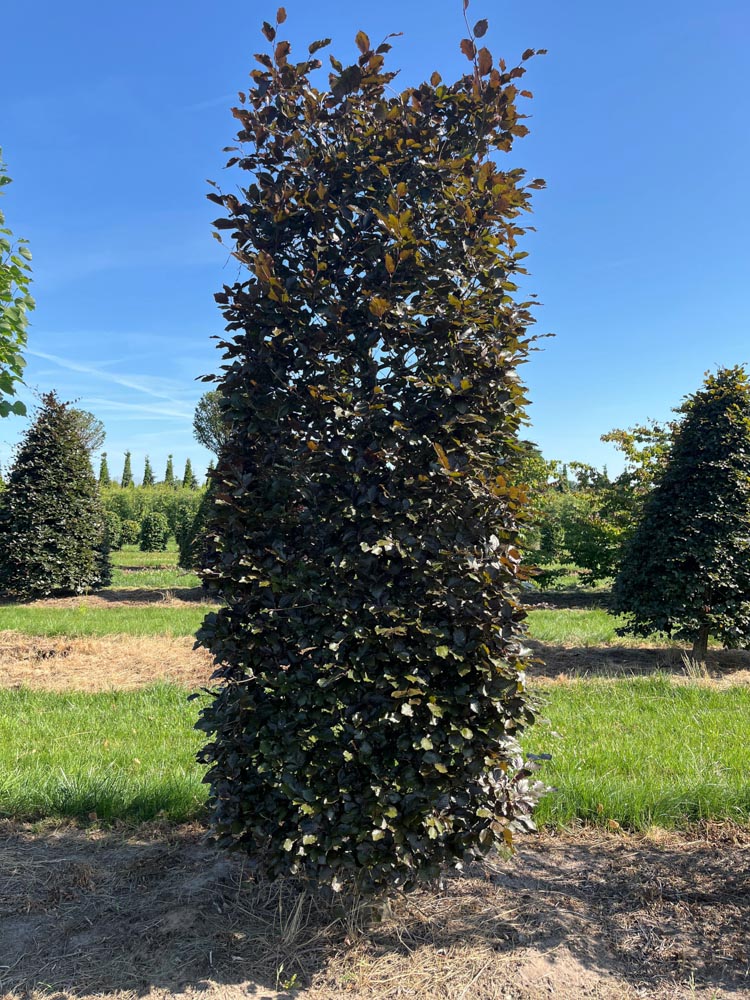
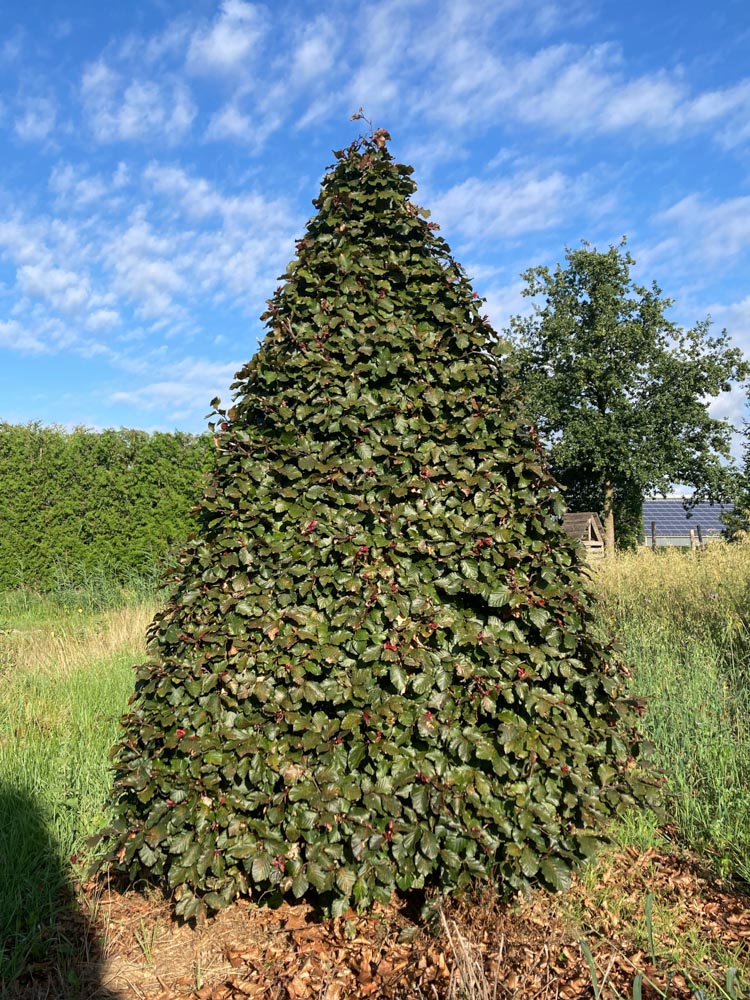
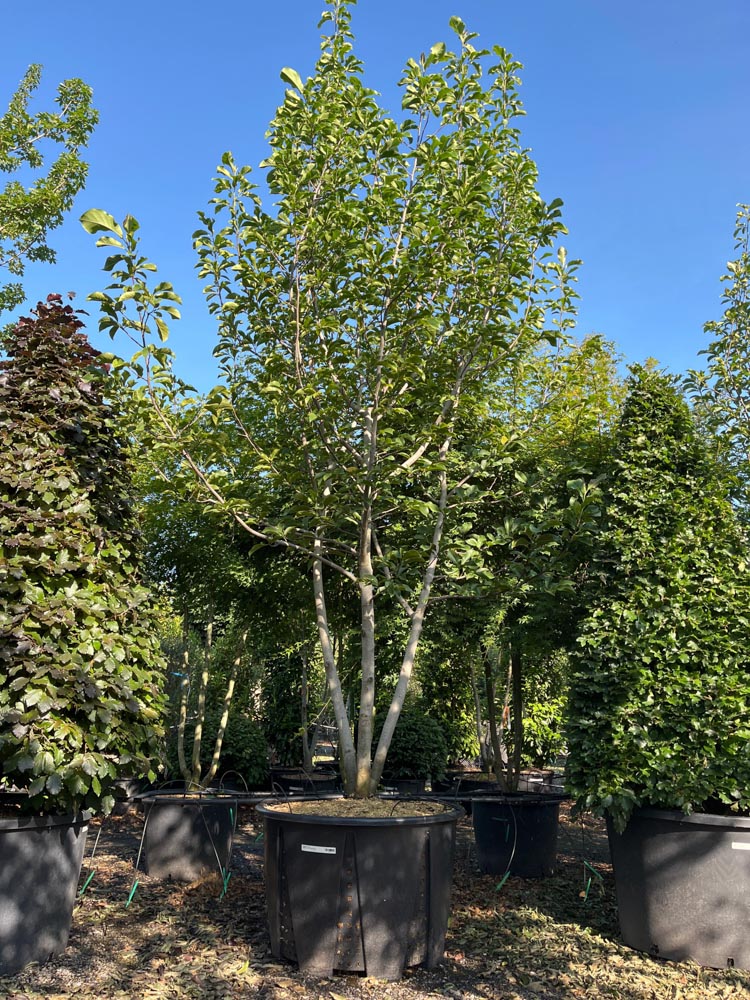
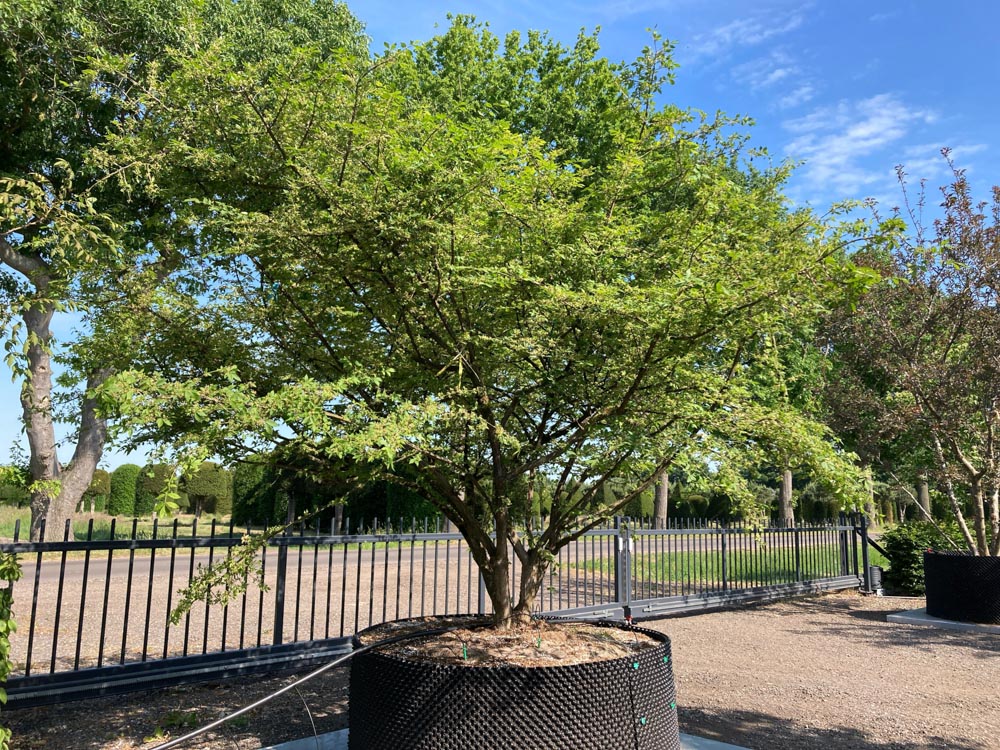
Fagus sylvatica Atropunicea Red beech height 225 cm in wire root ball

About Fagus sylvatica Atropunicea

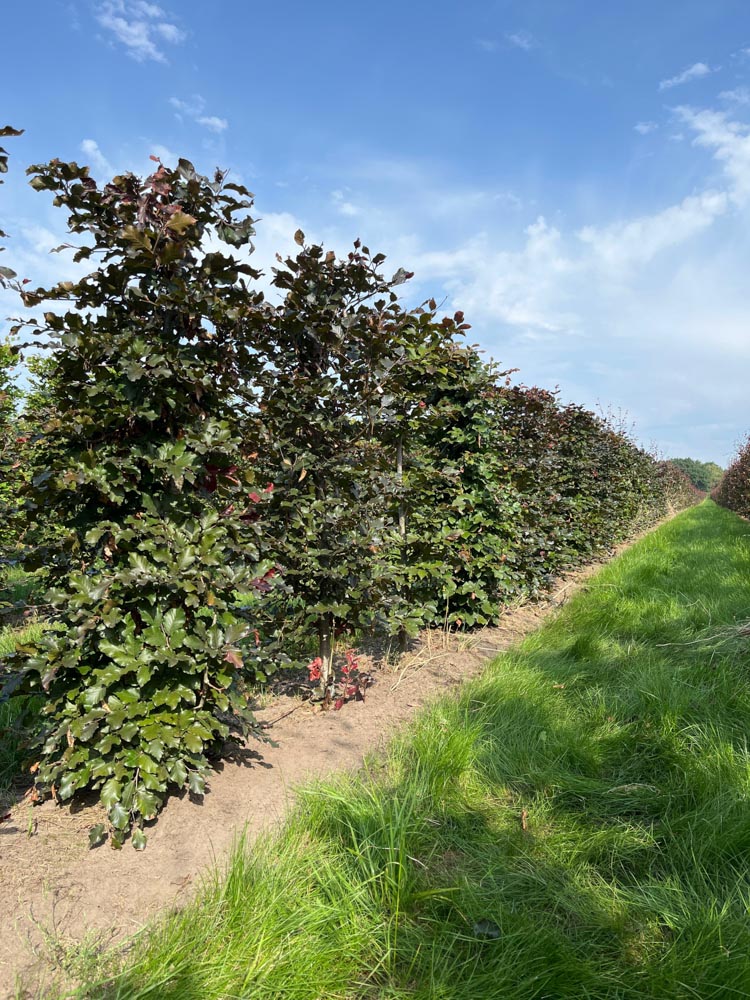
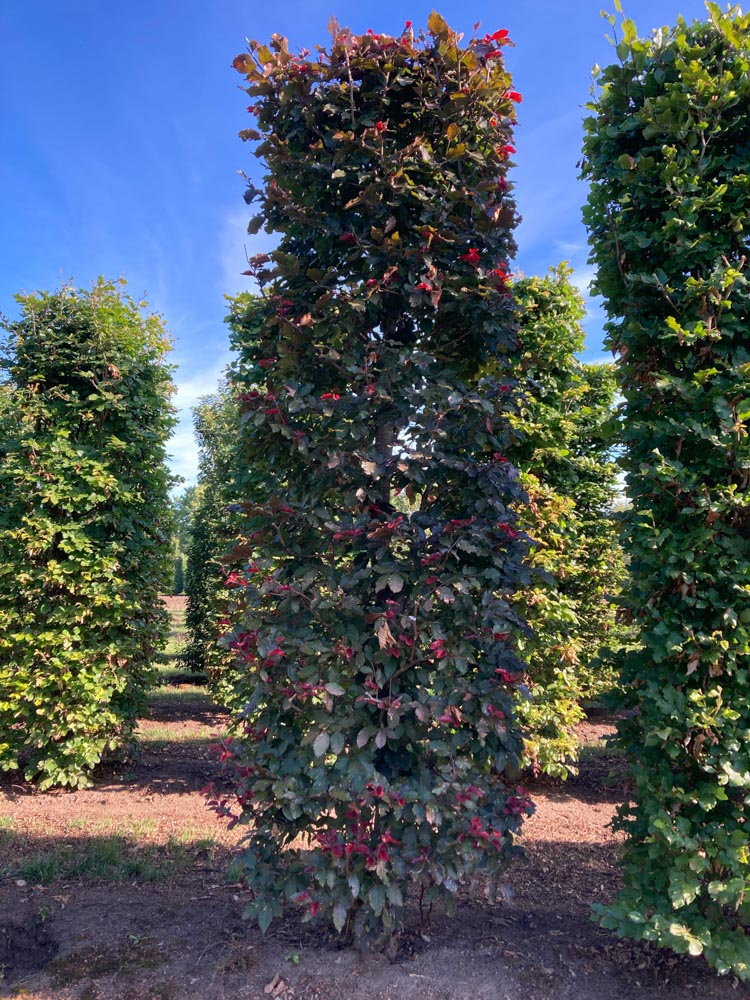
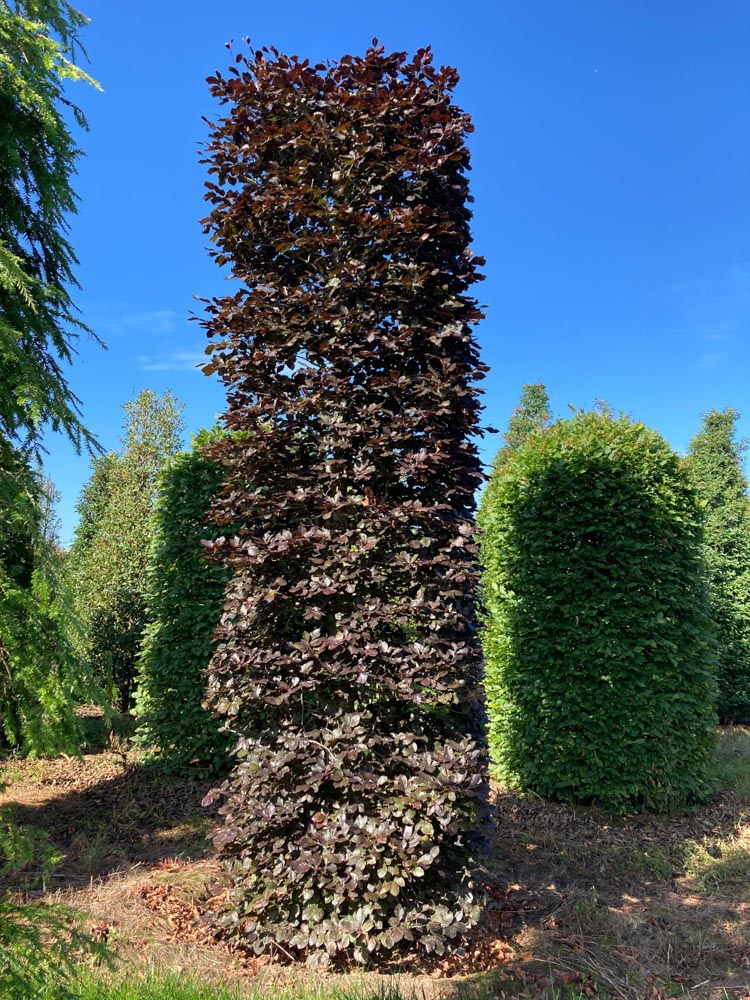
Red beech is a colour variety of common beech distinguished by its dark red to purple leaves. This imposing tree is among the most beautiful deciduous trees and combines the elegant growth habit of the beech with a striking leaf colour. Its growth form is broad-kernel shaped with a strong, straight trunk and wide-spreading crown. Branching is fine and regular, creating a dense crown. The trunk is straight and vigorous with a smooth, grey bark characteristic of all beeches. This smooth, elephant-grey bark remains relatively smooth even on older trees and is highly decorative. The branches branch finely and regularly, with the lower branches often reaching down to the ground if the tree grows free-standing. The leaves are the great distinguishing feature: in spring, the leaves appear in a beautiful dark red, almost purple. These young leaves have a silky sheen. In summer, the colour becomes slightly duller and changes to dark red to bronze green, depending on the amount of light. In full sun, the leaf remains darker red, in shade it turns more greenish. In autumn, the leaves turn copper-brown before falling. The dead leaves often remain on the branches for a long time, especially on young trees, giving a reddish-brown screen in winter. Flowering in April-May is inconspicuous with small, drooping flowers. After flowering, beechnuts develop in prickly husks. These nuts are edible and used to be eaten, but they also contain substances that are not healthy in large quantities. Red beech grows moderately fast to fast, at 30-50 cm per year in its young stage. The tree can grow very large, up to 25-30 metres tall with an equally wide crown. Its imposing size and beautiful leaf colour make the red beech one of the most impressive park trees. The tree can grow very old and develops an increasingly distinctive shape over the years.

Application and location

Red beech is ideally suited as a solitary tree in large gardens, parks and estates. Due to its imposing size and beautiful leaf colour, this tree demands a prominent place. It is also very suitable for avenue planting and as a colour accent between green trees. For hedge planting, the red beech is less suitable than the green variety. Plant the tree in full sun for the best leaf colour. In too much shade, the leaves become more greenish. Red Beech grows in almost all soil types, from clay to sand, but prefers moist, nutrient-rich soil. Excellent hardiness down to -25°C. The tree tolerates wind reasonably well, but a sheltered spot gives nicer leaf colour. Give the tree plenty of space: at least 15-20 metres in diameter. Pruning is not necessary. Note that this tree grows very large and provides a lot of shade. For those with space and looking for a spectacular colour tree, this is a top choice. The tree is suitable for large gardens and park-like settings.

Do you already know exactly what you need?

Every garden and every greenery project is different. Therefore, at Smits Arboriculture we do not make standard quotations, but we like to look together at what suits your wishes, planning and the character of the project.


our opinion

The properties below show the ideal conditions for a Fagus sylvatica Atropunicea. They help choose the right species for your project, but may vary slightly from one garden or project to another.

the runners

This is a list of the most frequently selected products. Looking for a specific product? Visit contact with us and we will be happy to help you personally. 

Dimensions

Value

Delivery form

Feature

Photo

Height
225 cm
Wire clod
Topiary
33800-1.jpg

Is the image missing?
Mail to info@smitsbv.nl

Height
375 cm
Wire clod
Topiary
45165-1.jpg

Is the image missing?
Mail to info@smitsbv.nl

Dimensions
125 cm x 50 x 50 cm
Coconut box
Smits Hedging
84590-1.jpg

Is the image missing?
Mail to info@smitsbv.nl

Dimensions
150 cm x 50 x 50 cm
Coconut box
Smits Hedging
84629-1.jpg

Is the image missing?
Mail to info@smitsbv.nl

Dimensions
175 cm x 50 x 50 cm
Coconut box
Smits Hedging

Is the image missing?
Mail to info@smitsbv.nl

Dimensions
325 cm x 100 x 100 cm
Wire clod
Smits Hedging
51226-1.jpg

Is the image missing?
Mail to info@smitsbv.nl

Dimensions
350 cm x 100 x 100 cm
Wire clod
Smits Hedging
84158-1.jpg

Is the image missing?
Mail to info@smitsbv.nl

Dimensions
425 cm x 100 x 100 cm
Wire clod
Smits Hedging
84737-1.jpg

Is the image missing?
Mail to info@smitsbv.nl

Dimensions
425 cm x 150 x 150 cm
Wire clod
Smits Hedging
84740-1.jpg

Is the image missing?
Mail to info@smitsbv.nl

Height
70 cm
Container
Flat sphere

Is the image missing?
Mail to info@smitsbv.nl

Height
80 cm
Container
Flat sphere

Is the image missing?
Mail to info@smitsbv.nl

Height
90 cm
Container
Flat sphere

Is the image missing?
Mail to info@smitsbv.nl

Height
250 cm
Wire clod
Pyramid
42253-1.jpg

Is the image missing?
Mail to info@smitsbv.nl

Height
225 cm
Container
Cone
89689-1.jpg

Is the image missing?
Mail to info@smitsbv.nl

Height
250 cm
Container
Cone
89674-1.jpg

Is the image missing?
Mail to info@smitsbv.nl

Height
300 cm
Wire clod
Cone
293-1.jpg

Is the image missing?
Mail to info@smitsbv.nl

Height
300 cm
Container
Cone
89680-1.jpg

Is the image missing?
Mail to info@smitsbv.nl

Height
350 cm
Wire clod
Cone
84475-1.jpg

Is the image missing?
Mail to info@smitsbv.nl

Height
200 cm
Container
Cylinder
89678-1.jpg

Is the image missing?
Mail to info@smitsbv.nl

Height
225 cm
Container
Cylinder
89687-1.jpg

Is the image missing?
Mail to info@smitsbv.nl

Height
130 cm
Wire clod
Globe

Is the image missing?
Mail to info@smitsbv.nl

Height
140 cm
Wire clod
Globe

Is the image missing?
Mail to info@smitsbv.nl

Height
225 cm
Wire clod
Beehive
54442-1.jpg

Is the image missing?
Mail to info@smitsbv.nl

Diameter
35-40 cm tall
Wire clod
/
581-1.jpg

Is the image missing?
Mail to info@smitsbv.nl

Diameter
40-45 cm tall
Wire clod
/
70538-1.jpg

Is the image missing?
Mail to info@smitsbv.nl

Is the Fagus sylvatica Atropunicea you are looking for not listed?

No worries. Chances are we still have the species you are looking for! Visit contact with us and we will be happy to help you. 

Every garden and every greenery project is different. Therefore, at Smits Arboriculture we do not make standard quotations, but we like to look together at what suits your wishes, planning and the character of the project.

Get inspired by our park, container field and the way trees and hedges come together in the design. Ideal for getting ideas for your next project.
Discover how gardeners and designers apply our greenery in high-quality garden and green space projects. From villa gardens to larger landscape projects.

FAQ

Frequently asked questions about Fagus sylvatica Atropunicea

Red beech can grow into a very large tree of 25-30 metres tall with an equally wide crown. The growth rate is moderately fast to rapid, with 30-50 centimetres per year in the young stage. It does take decades for the tree to reach its full size. The imposing final size makes the red beech suitable only for very large gardens, parks and estates. The tree requires a lot of space, both in height and width.
The red colour comes from a high content of anthocyanins in the leaves. These plant compounds give the red to purple colour. Red beech is a natural colour variation of common beech created by a genetic mutation. This mutation is passed on to offspring. The intensity of the colour depends on the amount of light: in full sun the leaf remains darker red, in shade it becomes more greenish because more chlorophyll is produced.
Yes, the red beech is deciduous. What is special is that the dead leaves remain on the tree for a long time, especially on young trees and on the lower branches of older trees. In autumn, the leaves turn copper-brown before dying off. These dead, brownish-red leaves often remain on the tree until spring, giving a reddish-brown winter screen. This is a characteristic feature of beech that is also appreciated in hornbeams.
Yes, the red beech is extremely hardy and tolerates temperatures down to -25°C without any problems. The tree is just as hardy as the common beech. In Dutch winters, the tree does not need any protection. Late spring frost is not a problem either. Its winter hardiness makes this a very reliable tree for our climate. Only young trees may suffer from branch breakage in very harsh winters with snow, but this is rare.
Red beech has a moderate to rapid growth rate of 30-50 centimetres per year in its young stage. This is similar to common beech. As the tree ages, the growth rate decreases slightly. On a good, moist site, the tree grows faster than on dry, poor soil. It takes up to 20-30 years to have a substantial young tree. Beech trees live long and continue to grow, albeit more slowly, into old age.
For the most beautiful leaf colour, plant red beech in full sun. Too much shade will make the leaves more greenish because more chlorophyll will be produced. The tree grows in almost all soil types but prefers moist, nutrient-rich soil. Calcareous soil is also well tolerated. The tree tolerates wind reasonably well, but a somewhat sheltered location gives more beautiful leaf colours. Avoid very dry, poor sandy soil.
In principle, yes, but green beech is more common and suitable for this purpose. Red beech can be used as a hedge and tolerates pruning well, but the disadvantage is that the red colour becomes more greenish in the shade of the hedge. So for a red hedge, you need full sun. Moreover, red beech is more expensive to buy. For hedge use, the common green beech is therefore usually chosen, unless you specifically want a red hedge.
Yes, beeches have a very dense crown that allows little light through. Almost nothing grows under a fully grown red beech due to lack of light. Only shade-loving plants such as ivy, wild honeysuckle or ferns can survive under a beech. This is important to know when planning: count on a large shade zone under the tree. For those seeking shade, this is an advantage, but for those who would like to grow something under the tree, this is a challenge.
See also