Caucasian zelkova

Family: Elm family

Zelkova carpinifolia

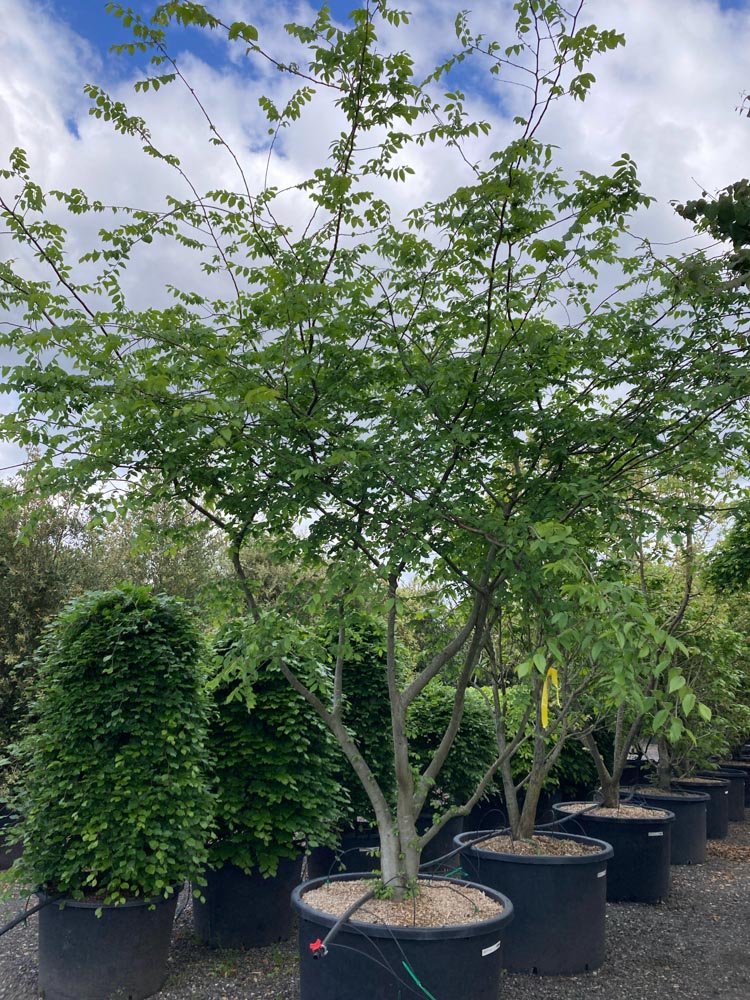
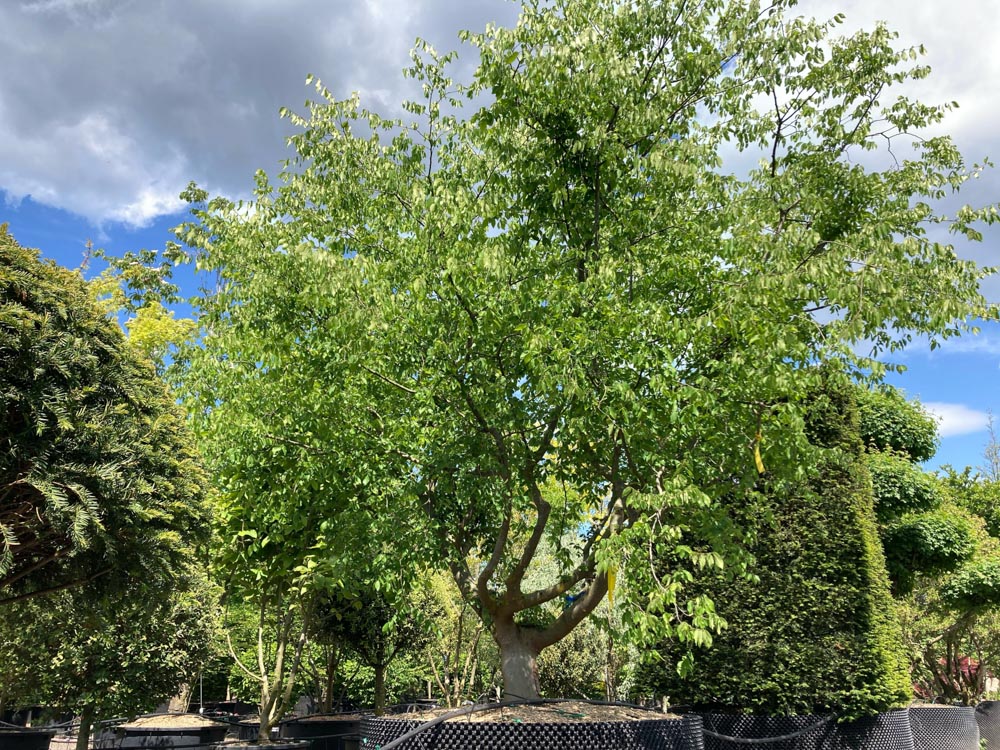
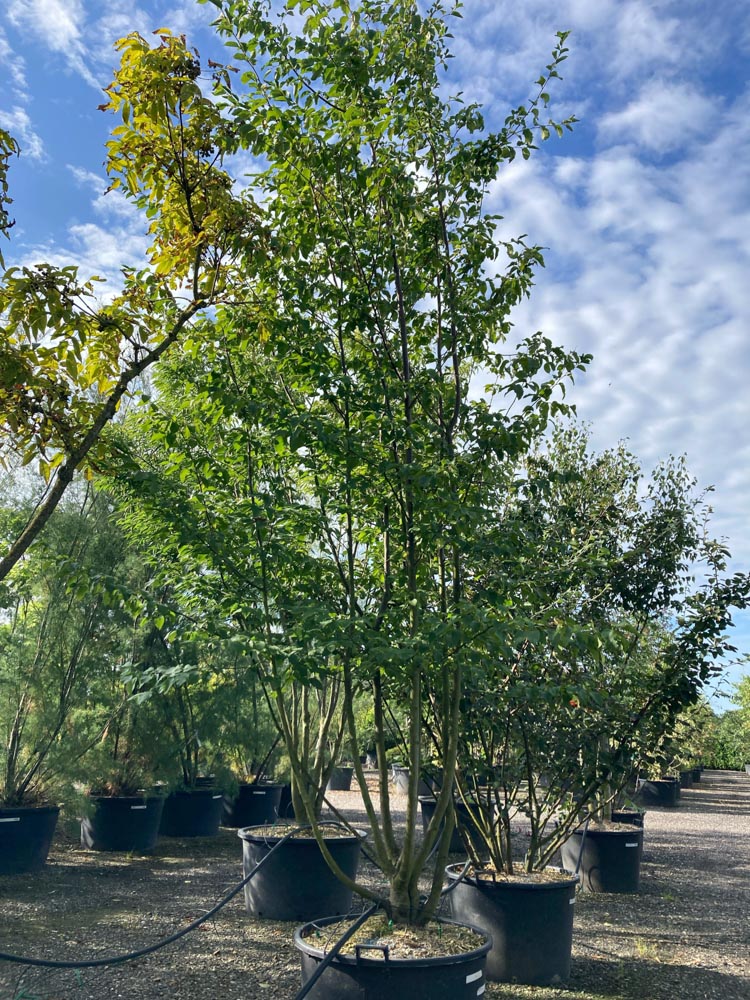
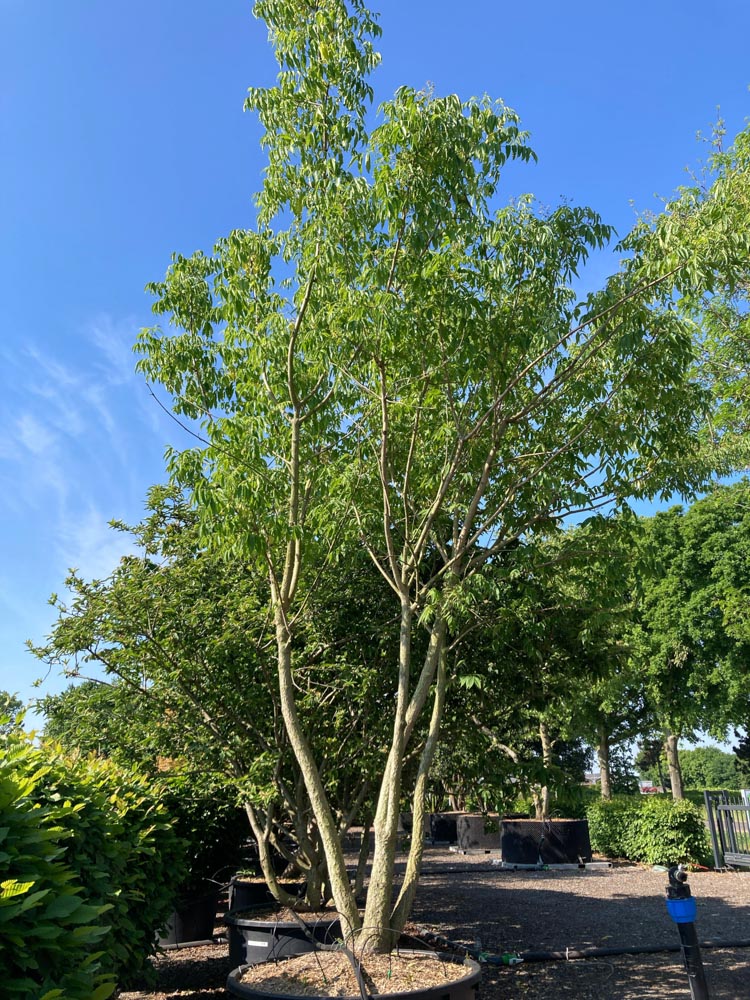
Zelkova carpinifolia Caucasian zelkova height 300/350 cm in container

About Zelkova carpinifolia

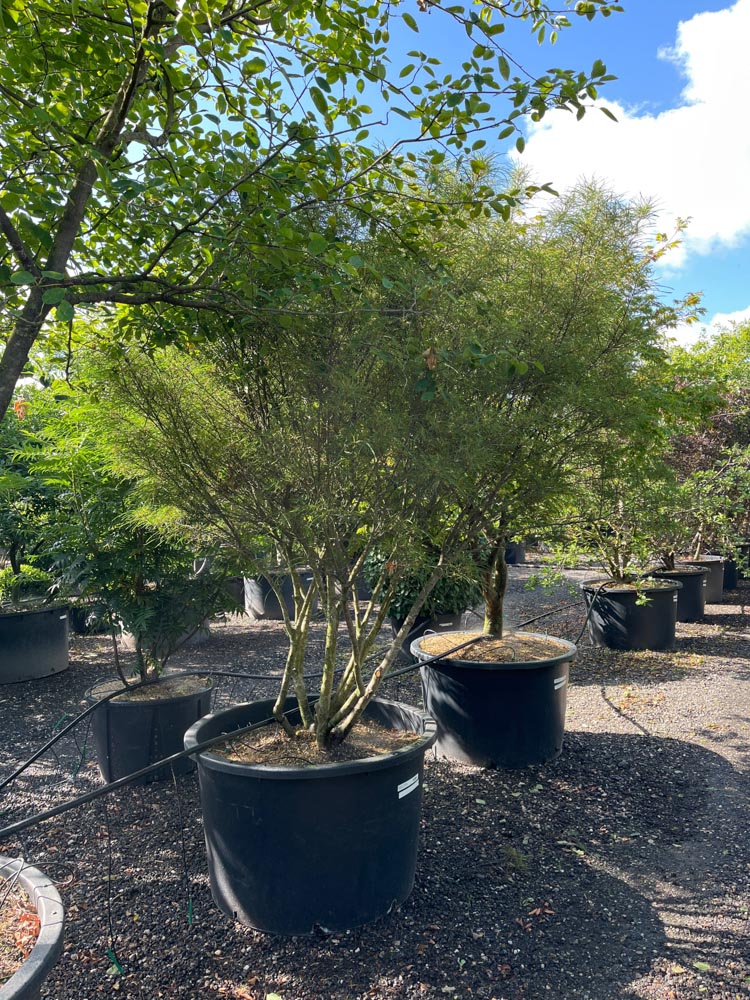
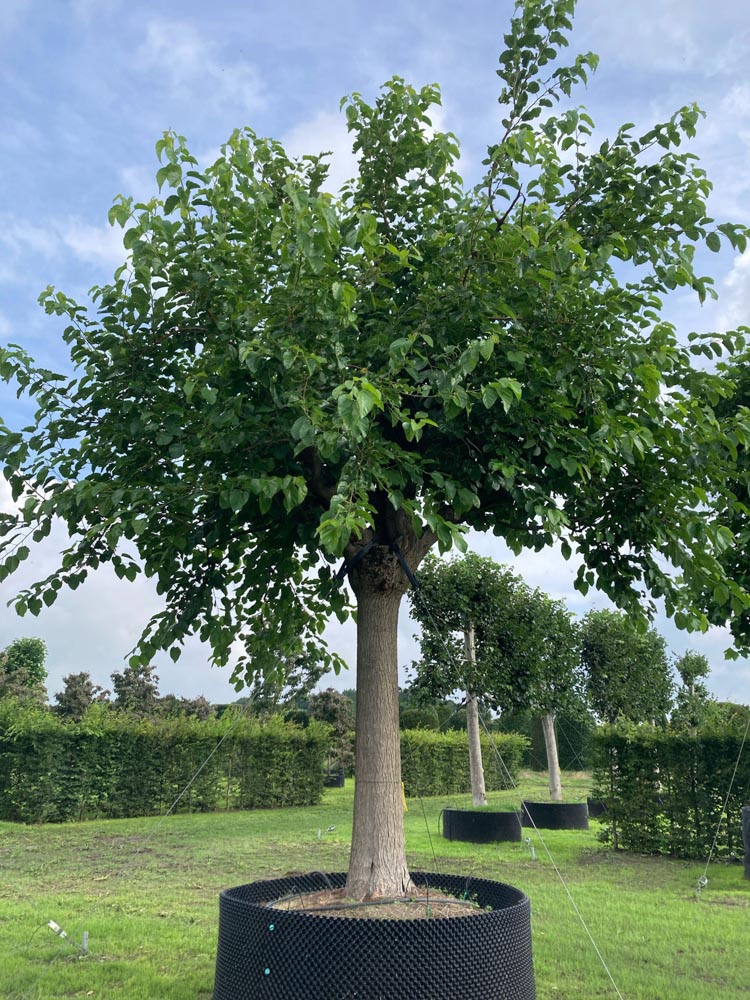
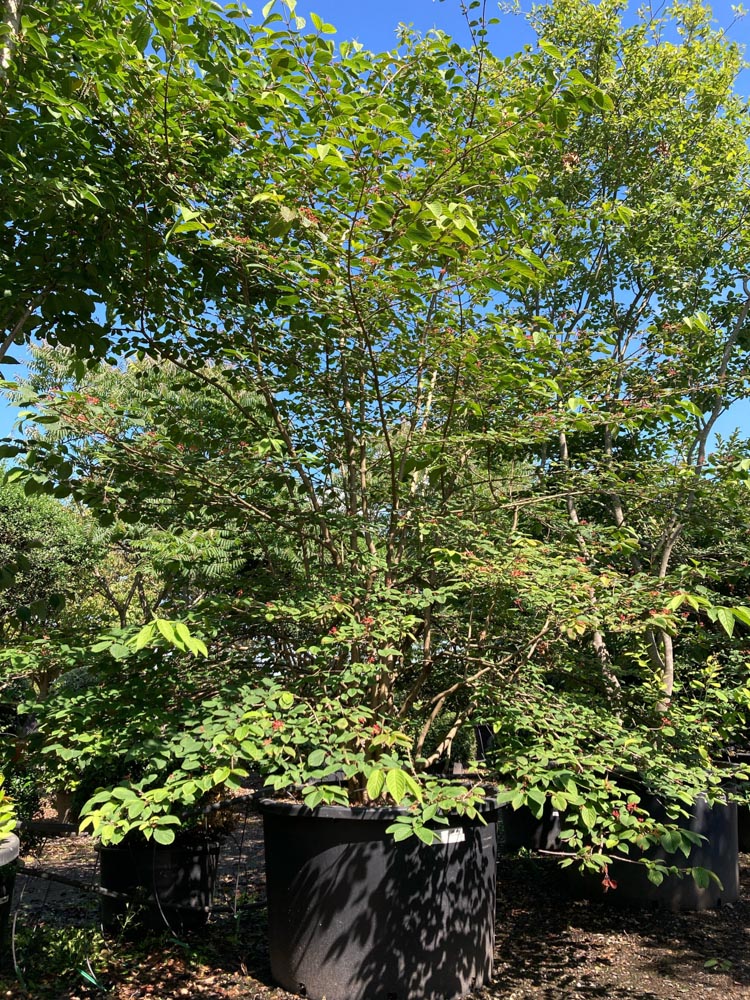
Zelkova carpinifolia, the Caucasian zelkova, is native to the Caucasus and northern Iran, where it grows in rich mountain forests on calcareous soils. It belongs to the elm family and is closely related to elms, but has a completely distinct character and silhouette. The tree is most recognisable by its unusual growth habit: the trunk splits low into a large number of steeply rising main branches that together form a dense, broom-like framework. In old age, this gives a broad, imposing crown roof with an unmistakable character. The trunk is grey and slightly mottled with a smooth, flaking bark pattern. The leaves are oval-shaped, finely toothed and resemble those of hornbeam - hence the name carpinifolia. In spring, the leaves sprout fresh green; in summer they are dark green. In autumn, the leaves turn yellow. Flowering is inconspicuous: small green flowers early in spring. The fruits are small, brown nuts. The growth rate is moderate. Special feature: the Caucasian zelkova has a high resistance to Dutch elm disease. Smits supplies it as a multi-stemmed tree of 300 to 450 centimetres.

Application and location

Zelkova carpinifolia is an excellent choice for parks, avenues and large gardens where a monumental, long-lived tree is desired. As a solitary multi-stemmed tree, it has a sculptural, impressive character that increases with age. Position: full sun to semi-shade. Soil type: loam, clay and sand; good moisture management is preferred. Drought-tolerant and wind-resistant; suitable for urban environments. Fully hardy. Point of attention: the Caucasian zelkova can eventually develop a very wide crown - plant it at a sufficient distance from buildings and structures. Its resistance to Dutch elm disease makes it a safe alternative to classic avenue trees such as elm.

Do you already know exactly what you need?

Every garden and every greenery project is different. Therefore, at Smits Arboriculture we do not make standard quotations, but we like to look together at what suits your wishes, planning and the character of the project.


our opinion

The features below show the ideal conditions for a Zelkova carpinifolia. They help choose the right species for your project, but may vary slightly from one garden or project to another.

the runners

This is a list of the most frequently selected products. Looking for a specific product? Visit contact with us and we will be happy to help you personally. 

Dimensions

Value

Delivery form

Feature

Photo

Height
300/350 cm
Container
Multi-strain
89160-1.jpg

Is the image missing?
Mail to info@smitsbv.nl

Height
350/400 cm
Container
Multi-strain

Is the image missing?
Mail to info@smitsbv.nl

Height
400/450 cm
Container
Multi-strain

Is the image missing?
Mail to info@smitsbv.nl

Height
400/450 cm
Container
/
89529-1.jpg

Is the image missing?
Mail to info@smitsbv.nl

Is the Zelkova carpinifolia you are looking for not listed?

No worries. Chances are we still have the species you are looking for! Visit contact with us and we will be happy to help you. 

Every garden and every greenery project is different. Therefore, at Smits Arboriculture we do not make standard quotations, but we like to look together at what suits your wishes, planning and the character of the project.

Get inspired by our park, container field and the way trees and hedges come together in the design. Ideal for getting ideas for your next project.
Discover how gardeners and designers apply our greenery in high-quality garden and green space projects. From villa gardens to larger landscape projects.

FAQ

Frequently asked questions about Zelkova carpinifolia

Caucasian zelkova has a distinctive broom bushy growth habit: the trunk splits low into a large number of steeply rising main branches that together form a dense, round to broad crown. This gives the tree an unmistakable, monumental silhouette that is particularly imposing in old age. In winter, when the tree is bare, this branch pattern is most impressively visible.
Zelkova carpinifolia is a large tree that can reach more than 15 metres. In favourable conditions in its home area the Caucasus, specimens reach 25 to 35 metres. In the Netherlands, it grows more slowly but steadily builds up an impressive tree. Smits supplies multi-stemmed specimens of 300 to 450 centimetres as a starting point.
Yes, Zelkova carpinifolia has high resistance to Dutch elm disease (Ophiostoma novo-ulmi). This makes it a valuable alternative to elms in urban planting and avenue designs. Although complete immunity does not exist, the risk of severe infestation is significantly lower than for the common elm. This increases life expectancy and reduces long-term management costs.
In autumn, the leaves of Zelkova carpinifolia turn yellow. The autumn colour is pleasant but less spectacular than that of its relative Zelkova serrata. After leaf fall, the broom-like branch structure is fully visible, giving the tree a particularly architectural character in winter.
Loam, clay and sand are suitable; well-moisturised but permeable soil gives the best growth. Drought tolerance is good, making it suitable for summer droughts. The tree is wind-resistant and tolerant of air pollution. In its home area, it grows on calcareous soils, indicating that calcareous soil is not an objection.
Yes, Zelkova carpinifolia is increasingly used as avenue tree, partly as an alternative to elms susceptible to Dutch elm disease. Its tight, upward growth in youth lends itself well to avenue structures. In old age, the crown widens; plant it at sufficient intervals (at least 8 to 10 metres) to give space to the wide mature crown.
Yes, the Caucasian zelkova is fully hardy in the Netherlands. As a mountain tree of the Caucasus, it is used to cold winters and large temperature fluctuations. Extra protection is not necessary. In winter, the tree fully displays its characteristic broom-bush branch structure, giving it a striking presence even in the cold season.
The growth rate is moderate: 20 to 40 centimetres per year in favourable conditions. The tree builds a solid, durable structure that reaches monumental proportions in the long term. Smits supplies pre-cultivated multi-stemmed specimens of 300 to 450 centimetres for those who want a substantial starting point quickly.

See also